
Auto Parts Sector Defies Market Downturn as This Company Hits 20% Daily Limit Up
On December 16, influenced by external markets, China's A-share indices collectively opened lower in early trading. However, sectors including retail, education, and auto parts bucked the trend to show strength.
Specifically, Wind Information data shows that multiple stocks in the automotive and parts sector surged significantly. As of press time, three component stocks—Zhejiang Shibao, Weidi Co., Ltd., and Soling Co., Ltd.—hit the daily limit up, while Sunway Precision Engineering Co., Ltd. rose over 16%. Several other stocks followed suit, including Haoen Automotive Electronics, BAIC Blue Valley, and Tianpu Co., Ltd., with BAIC Blue Valley nearing the limit up.
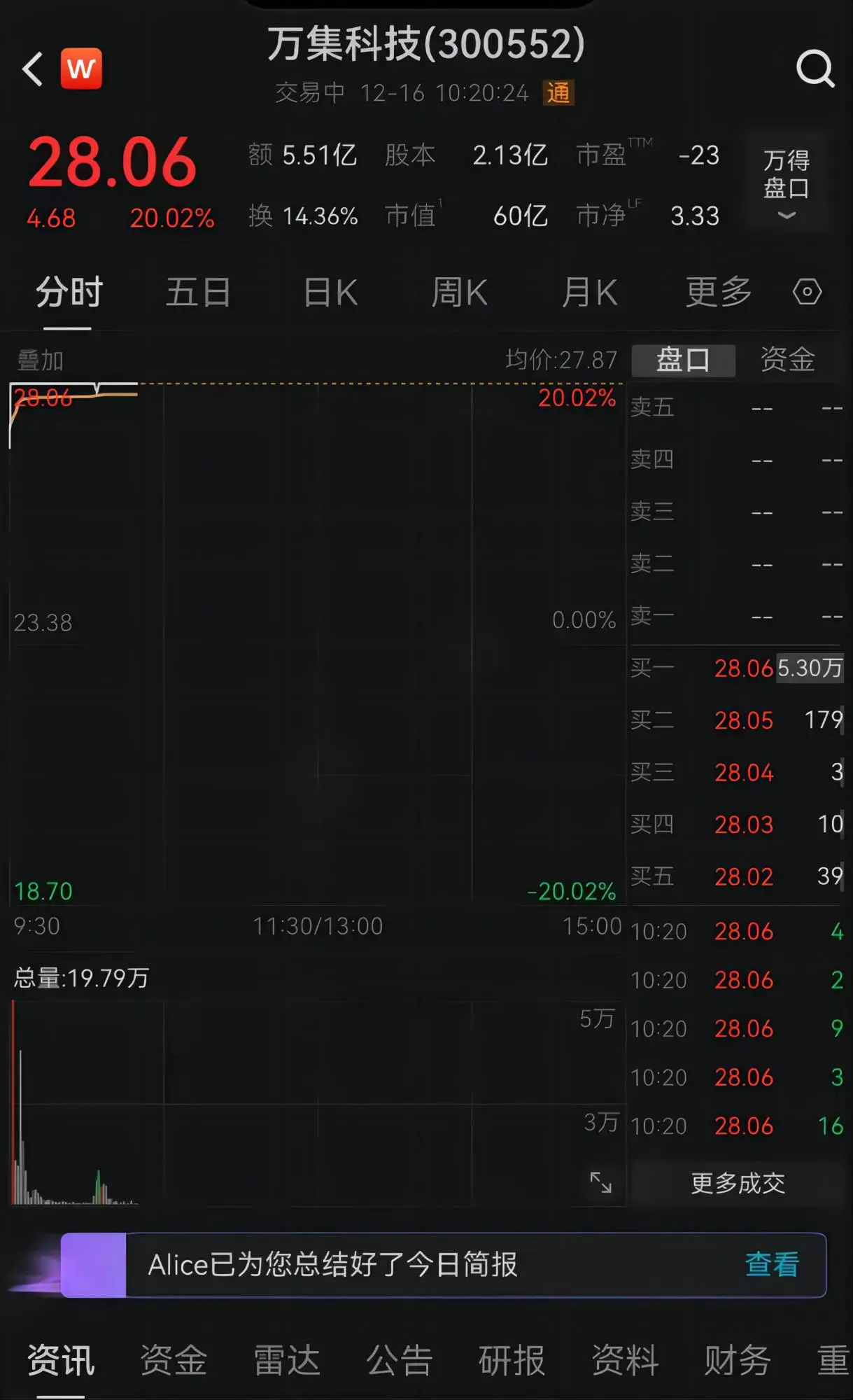
Additionally, within the vehicle-road-cloud concept sector, Wanji Technology surged to its 20% daily limit within one minute of the market opening. Other component stocks, including Zhonghaida, Wanma Technology, and Luchang Technology, also rose.
Industry insiders believe that the release of multiple favorable policies has significantly boosted sectors like automotive and autonomous driving. On December 15, the Ministry of Industry and Information Technology officially announced China's first batch of L3 conditional autonomous driving vehicle access permits. Two models, tailored for urban congestion and highway driving respectively, will undergo road trials in designated areas of Beijing and Chongqing. This marks a crucial step for China's L3 autonomous driving technology, transitioning from the testing phase to commercial application.
A research report by Cinda Securities indicates that domestic regulations governing intelligent connected vehicles are continuously improving, with the industry's development environment gradually becoming standardized. Concurrently, domestic brands are accelerating R&D in intelligent driving technologies, driving sustained growth in the industry's intelligent driving penetration rate. In the realm of high-level autonomous driving, Robo-X continues to be deployed. The market size for robotaxis is projected to reach 270 billion yuan by 2030. Furthermore, unmanned logistics vehicles are gradually being implemented, with the incremental output value of China's unmanned logistics vehicle industry expected to rise to 594.8 billion yuan by 2030.
The “Guidelines for Compliance with Price Behavior in the Automotive Industry (Draft for Comment)” issued by the State Administration for Market Regulation aims to regulate automotive price competition across the entire supply chain and establish clear boundaries. This initiative is expected to have profound and multifaceted impacts on the automotive industry. With eight departments including the Ministry of Industry and Information Technology explicitly stating ‘conditional approval for production access of Level 3 autonomous driving models’ and announcing the first batch of approvals, the commercialization of high-level intelligent driving has accelerated significantly. This signals robust growth momentum for the Level 3 autonomous driving sector next year," Yuan Shuai, Deputy Secretary-General of the Zhongguancun IoT Industry Alliance, told Securities Daily.
Additionally, it is worth noting that the State Administration for Market Regulation previously solicited public feedback on the “Guidelines for Price Compliance in the Automotive Industry (Draft for Comment).” This marks the first time regulators have systematically regulated pricing practices across the automotive supply chain through industry guidelines. Zhang Xiang, visiting professor at Huanghe University of Science and Technology, told Securities Daily: “The release of this draft imposes strict requirements on automakers' new vehicle sales and aftermarket parts pricing. If rigorously implemented, it could significantly constrain second- and third-tier new energy vehicle manufacturers.”